I recently attended a Citibank-hosted webinar focused on the T+1 Implementation Guide for European Markets. It was a fascinating session featuring Michele Pitts (Global Product Head of Transaction Management at Citi), Giovanni Sabatini (EU T+1 Industry Committee), and Andrew Douglas (UK Accelerated Settlement Taskforce) and Emma Johnson from ValueExchange . As I listened to them navigate the 80 percent compression in time that T+1 requires, it struck me that while the industry is obsessing over high-level metrics, we are overlooking the most valuable data source we already own.
The transition for the EU, UK, and Switzerland, slated for October 11, 2027, is a different beast compared to the U.S. move in 2024. We are looking at more than 20 CSDs, 25 currencies, and a fragmented regulatory landscape that requires total synchronization. The panel was clear: automation is the only viable path. In the U.S., firms that failed to automate saw an 18 percent jump in headcount costs and an 11 percent increase in failed settlements. In Europe, where firms already pay approximately €70 million a month in CSDR cash penalties, the stakes are even higher.
One point from the webinar really resonated: the industry only gets its act together when there is transparency. When the DTCC started publishing counterparty success rates for affirmations, firms suddenly found the budget to automate. But transparency should not just come from external peer pressure; it needs to come from within your own operations.
The Problem: What You Know vs. What You Do Not and Level 2 Data
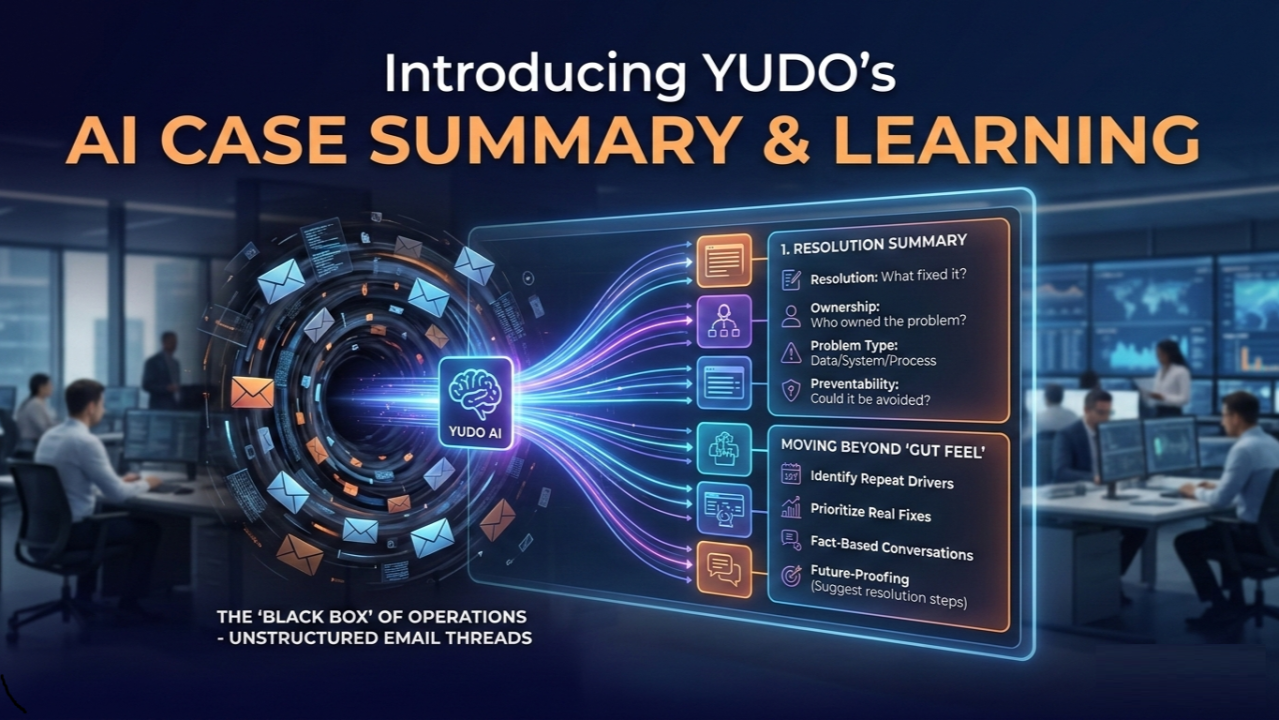
Most teams live off what I call Level 1 metrics. These are the lists of breaks, fail reasons, and country-level reports. They tell you what failed and with which counterparty, but they do not tell you how it was fixed. That Level 2 intelligence is currently trapped in the thousands of emails flowing through your shared mailboxes. Inside those threads are the specific manual workarounds, the human errors corrected, and the system gaps that your transformation team needs to see to justify investment.
This is why we developed YUDOradar.
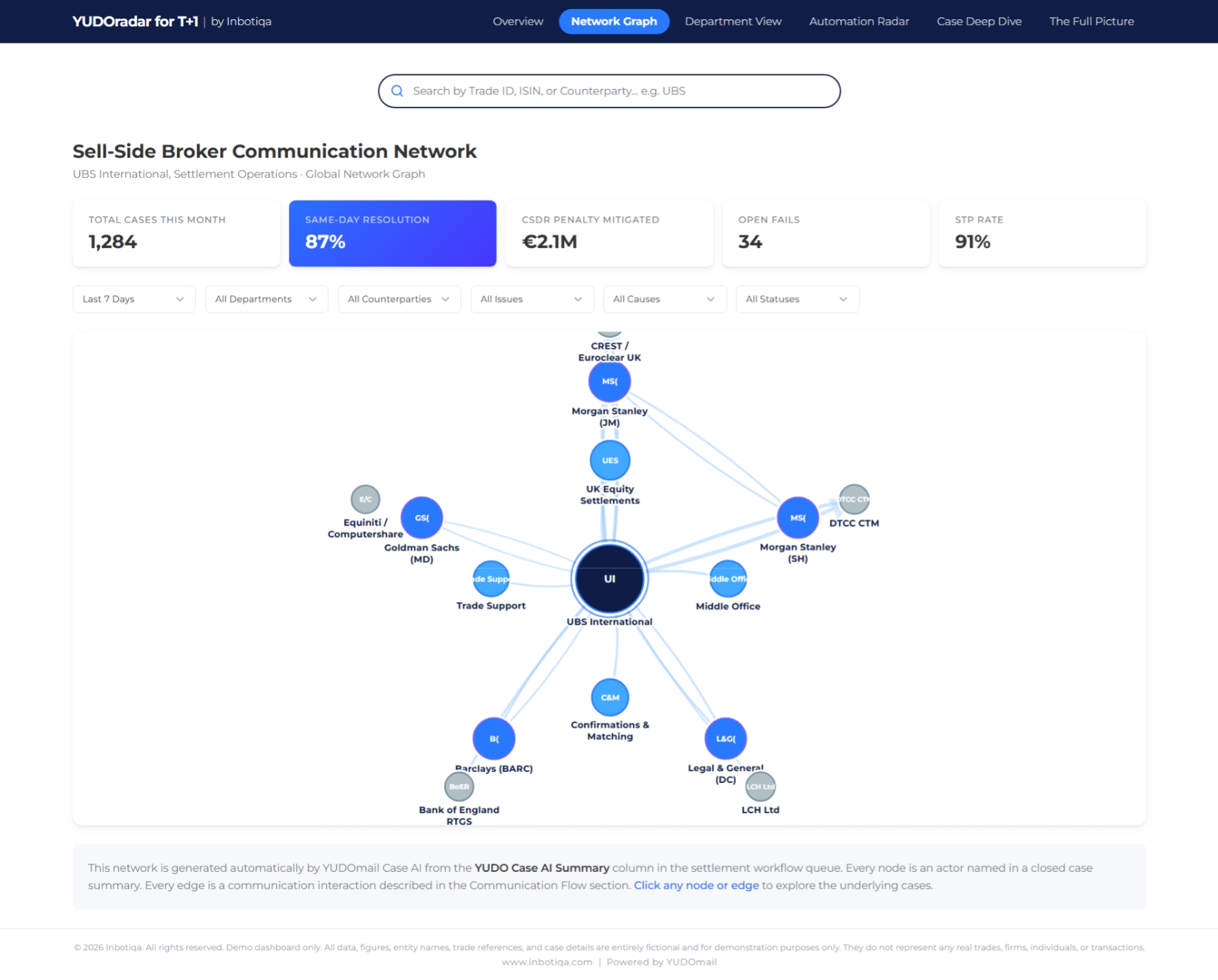
It struck me during the session that YUDO’s existing Case functionality, which is already live with Tier 1 banks, could be used to map the T+1 settlement ecosystem in real-time. We configured a social graph radar that turns these hidden email threads into a live automation opportunity list.
How YUDOradar Works
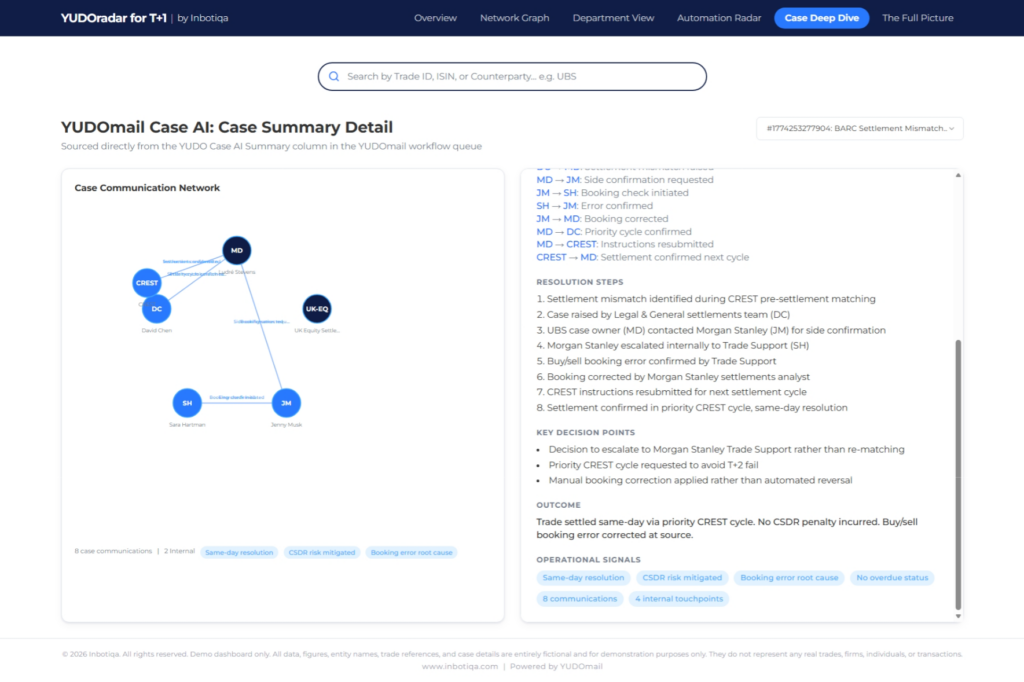
YUDOradar is a specific application of YUDOmail’s (or YUDOlistener) existing Case AI and Social Graph capabilities directed at the T+1 readiness problem. It automatically threads every inbound, outbound, and internal comment into a single settlement case. When that case is closed, the Case AI produces a structured summary of the actors involved, the resolution steps, and most importantly, the operational signals: the manual touchpoints required to resolve the trade.
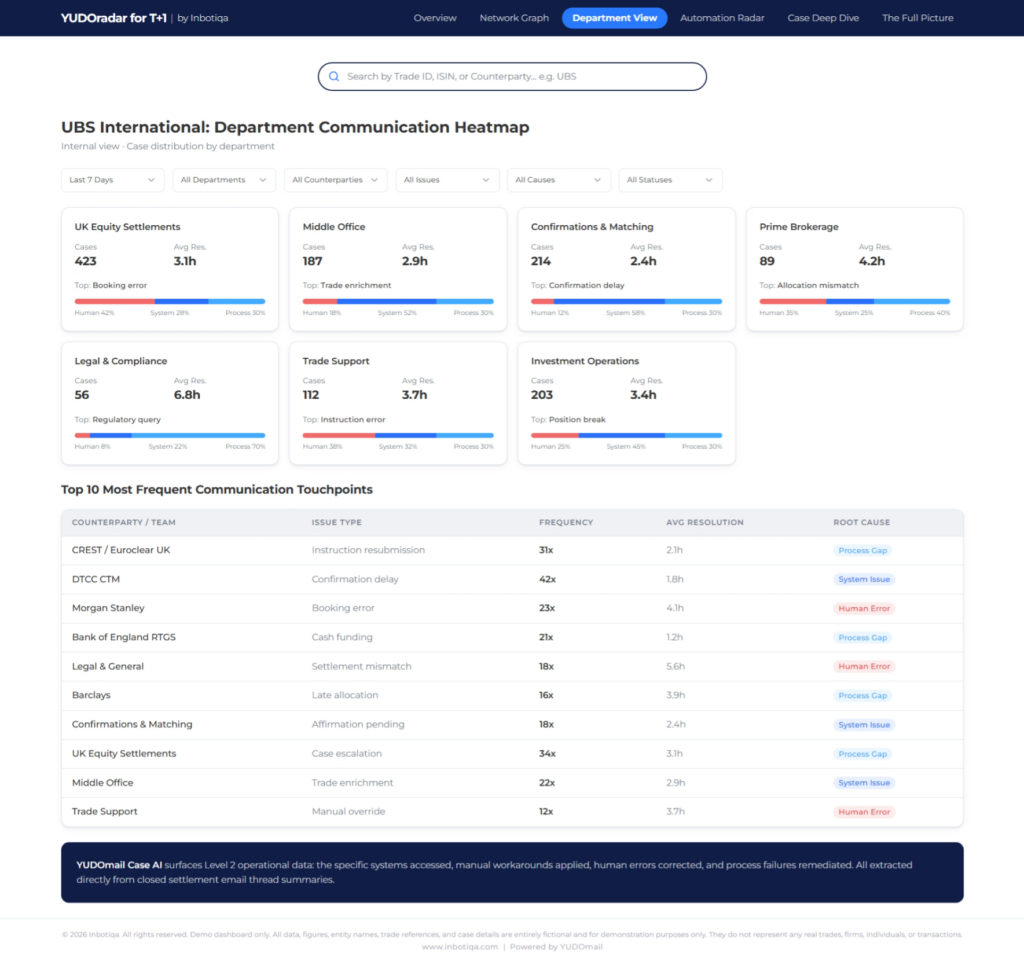
When you aggregate this across thousands of cases, you get a dashboard that finally shows you where to deploy your capital.
| View | What It Shows |
| Counterparty Communication Network | A live map of every counterparty and internal team communicated with. Node size reflects volume. |
| Automation Radar | A prioritized list of system enhancement opportunities with CSDR penalty exposure per gap. |
| Department Heatmap | Case volume and resolution time per internal department, split across Human Error, System Issue, and Process Gap. |
| Case Deep Dive | Full structured output per case, including actors, resolution steps, and decision points. |
Why This Matters Specifically for T+1
The ValueExchange Readiness Survey from January 2026 found that 58 percent of firms cite the removal of manual processes as their core challenge, yet 50 percent have still not decided on their trade flow automation plans. Furthermore, 69 percent of respondents have not yet engaged with their IT providers on T+1. The reason most programs stall at the planning stage is not a lack of intent: it is a lack of precision.
You cannot automate what you cannot see, and most firms cannot see what is inside their settlement email. YUDOradar turns those insights into a boardroom-ready business case for IT. Instead of guessing where the bottlenecks are, you can pinpoint the exact manual steps your teams took over the last 60 to 90 days.
Who This Is For
Whether you are a boutique investment manager or a Tier 1 broker with a massive operations floor, if your team runs on a shared inbox, this intelligence is already in your building.
- Asset Management and Ops: Manage shared inbox chaos and provide an audit trail for client instructions.
- Wealth Management: Track discretionary authorisations and client correspondence with full oversight.
- Brokerage and Trade Support: Handle high-volume settlement support and resolve allocation disputes faster.
- Settlements and Custody: Manage failed trades, SWIFT breaks, and counterparty chasers with a clear data signal.
- Compliance and Risk: Track regulatory queries and maintain a searchable history of reportable events.
The Countdown Has Started
The firms that will be ready in October 2027 are the ones that start with a precise view of where the gaps are today. YUDOradar gives you that view in 60 days. The 60-day QuickStart Pilot is available now and is procurable via the Microsoft Marketplace. If any of this resonates with your transition strategy, we can show you a live demo of the T+1.
Useful Links and Resouces
1. DTCC and Post-Trade Automation
These links provide a technical anchor for the automation arguments, specifically focusing on the European market.
- DTCC T+1 Automation Package for Europe: dtcc.com/accelerated-settlement/t1-automation-package
- DTCC Learning Center for T+1: dtcclearning.com/t1
- DTCC white paper on Building the T+1 Future: dtcc.com/dtcc-connection/articles/2024/january/04/building-the-t1-future-together
2. Official Taskforce and Committee Reports (The “Heavy Hitters”)
These are the primary documents for the UK and EU transition, essential for grounding the 11 October 2027 date.
- UK Accelerated Settlement Taskforce (AST) Technical Group Report (February 2025): gov.uk/government/publications/accelerated-settlement-t1
- ESMA T+1 Coordination Committee Landing Page: esma.europa.eu/esmas-activities/markets-and-infrastructure/shortening-settlement-cycle-t1-eu
- EU T+1 Securities Settlement Handbook (February 2026): esma.europa.eu/sites/default/files/2026-02/T_1_Coordination_Committee_20260205_SOC.pdf (This link points to the Summary of Conclusions which hosts the handbook links).
3. Industry Readiness and The ValueExchange Survey
This is the specific source for the statistics used in the post, such as the 77 percent awareness and the 69 percent lack of IT engagement.
- EU T+1 Industry Committee Readiness Survey (February 2026 Update): euronext.com/en/news/t1-programme-latest-publications-eu-t1-industry-committee
- The ValueExchange T+1 Research Portal: thevalueexchange.co/t1-settlement
4. Citibank Webinar and Implementation Insights
This provides the direct link to the guide that sparked the innovation point.
- Citi T+1 Implementation Guide for European Markets (February 2026): citigroup.com/global/insights/t-1-implementation-guide-for-european-markets
- Citi Investor Services: Transforming the Trading Lifecycle: citigroup.com/global/insights/t-1-transforming-the-trading-lifecycle-from-end-to-end
5. Supplemental Industry Analysis
Useful for the sections on CSDR penalties and the broader cost of settlement failure.
- AFME: T+1 Settlement in Europe (Benefits and Challenges): afme.eu/reports-publications/industry-reports/details/T1-Settlement-in-Europe-Potential-Benefits-and-Challenges
ICMA Resources on T+1 and Secondary Markets:icmagroup.org/market-practice-and-regulatory-policy/repo-and-collateral-markets/t-1-the-shortening-of-standard-settlement-cycles/