YUDOmail enables AI in email workflows, sentiment scoring and structured data inputs for LLMs, delivering operational transformation that is incremental, controlled, measurable, and human and team friendly.
Change inside companies is hard, especially when people worry that AI might take their jobs rather than just make it easier.
You hit resistance. Teams are unsure how to tackle it in management chunks, Then the learning curve. Then storming, forming, norming, performing. And sometimes at the end, people are not even sure whether the change delivered value because the before and after are impossible to compare.
With YUDOmail, we make this easy and a natural progress for high volume operational email environments.
A. What Actually Happens in YUDOmail
Let us assume you have never used YUDOmail before. Gere is what happens step by step when an email arrives.
1. Email Is Ingested using our Email Adaptor.
- YUDOmail connects to your shared mailbox. It does not replace Outlook or Gmail. It works with them.
- When an email arrives, YUDOmail ingests it automatically. Nothing changes for your external stakeholders. They still send emails as usual.
2. A Case Is Created
- Instead of leaving the email as a loose item in an inbox, YUDOmail creates a Case.
- A Case is a structured container that includes: The full email thread, All attachments, The subject and participants, Metadata fields such as client name, category, priority, due date, business unit, Status such as Open, In Progress, Waiting, Closed
- Every sent reply to that email is automatically threaded into the same Case.
- No more lost emails. No more forwarding chains. No more private sub conversations. One case. One source of truth.
3. Ownership Is Assigned
Each Case must have an Owner. Ownership is explicit. There is no ambiguity. You always know who is responsible.
This can be:
- A specific person
- system account
- An AI agent
- An RPA bot
4. Workflow Rules Trigger
YUDOmail allows you to define workflow rules.
For example:
- If subject contains SSIs, assign to Settlement Team
- If client tier equals Platinum, set priority to High
- If sentiment equals Negative, escalate to Manager
- If received after hours, set due date to next business morning
These rules can be simple or sophisticated. They are transparent and measurable.
5. AI Enhances the Case
Now the incremental AI layer begins.
When the Case is created, YUDOmail can:
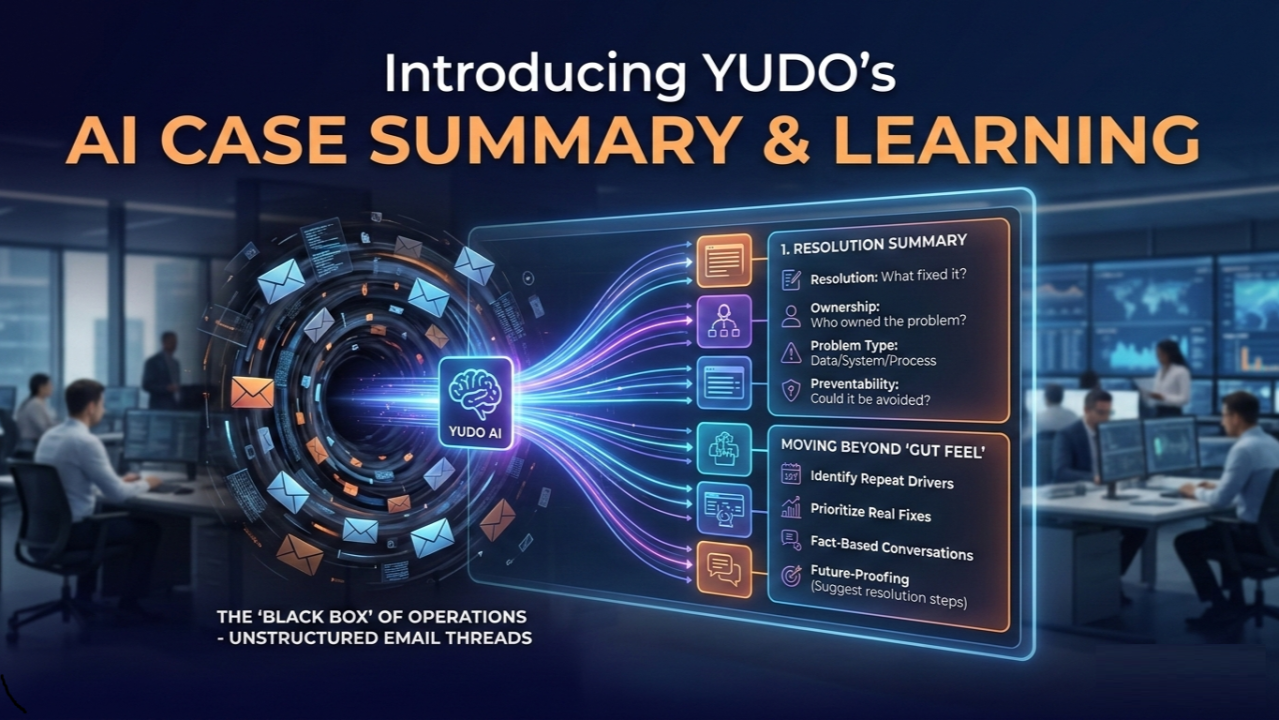
- Summarize the case
- Extract key entities
- Suggest next steps
- Surface historical similar cases
- Pre draft a response
The summary appears inside the Case.
For example: Case Summary Counterparty requests confirmation of Standard Settlement Instructions for EUR trade settling today. Due date set to today. Suggested Next Steps Retrieve SSIs for counterparty X in EUR. Confirm via template response. Attach PDF if required. The human does not lose control. They gain context.
6. Comments and Internal Chat
Inside the Case, team members can:
- Add internal comments
- Tag colleagues
- Ask questions
- Share documents
- Collaborate in real time
These comments are not visible to the external client. They are fully auditable and permanently linked to the Case. No more side WhatsApps. No more separate Teams threads. Everything stays inside the workflow container.
7. Audit Trail Records Who Did What
Every action in YUDOmail is recorded in the audit trail. The system shows clearly:
- Who created the Case
- Which rule assigned it
- When the owner accepted it
- Who commented
- Whether AI generated a summary
- Whether a bot responded
- When the email reply was sent
- When the Case was closed
And crucially: It records whether the action was performed by:
- System
- AI
- Human
- Bot
This is critical for risk, compliance, and governance. You can see the full lifecycle of work.
Example 1. Investment Banking Middle Office
Imagine a European shared mailbox. Ten people in London. Ten people in Manila. High volume inflow.
An email arrives: Please confirm your Standard Settlement Instructions for this upcoming trade.
Here is what happens in YUDOmail.
- Email arrives.
- Case is created automatically.
- Rule detects SSIs in subject.
- Case assigned to Settlement Queue.
- Due date set to Today.
- AI summarizes request.
- Suggested next steps displayed.
A team member accepts the Case.
They retrieve SSIs. Reply. Close the Case.
At month end, management reports show:
- 200 SSI confirmation requests
- Average turnaround time
- SLA compliance
- Sentiment score
- Escalation rate
Now leadership sees a pattern. Instead of a big bang AI transformation, they make one decision.
New rule: If subject contains SSIs, assign to RPA Bot.
Now:
- Email arrives
- Case created
- Assigned to Bot
- Bot retrieves SSIs
- Bot sends template reply
- Case closed
- Audit trail records Bot action
Humans focus on exceptions. No disruption. No panic. Incremental automation.
Example 2. Medium Sized Financial Services Firm
A firm with 50 staff and a shared Client Services inbox. They start simple.
Phase 1 Just use YUDOmail to create Cases and assign owners.
Already they gain:
- Visibility
- Clear accountability
- Measurable SLAs
- No lost emails
Phase 2 Turn on AI summarization and suggested next steps.
Now new joiners ramp up faster. Knowledge is surfaced automatically. Training burden reduces.
Phase 3 Introduce sentiment scoring.
Each Case is rated:
- Positive
- Neutral
- Negative
Management dashboards show:
- Which clients are becoming frustrated
- Which teams respond poorly
- Where tensions are building
This is not just workflow. This is risk management and client experience intelligence.
Phase 4 Automate specific repeatable categories.
Not everything. Only where data supports it.
Incrementally. Controlled. Measured.
B. Why This Matters
AI in organizations fails when it is forced top down. Big bang. Mass retraining. Radical process shifts. Fear of job loss. YUDOmail takes a different path.
It does not remove email. It structures it. It makes it measurable. It makes it governable. It makes it improvable.
Then, once you can measure it, you can:
- Improve it
- Assist it with AI
- Automate parts of it
- Eliminate unnecessary work
- Proactively communicate
And because every action is logged in the audit trail, you always retain control.
You can see: System did this. AI suggested that. Bot responded here. Human approved there. That clarity builds trust.
Climbing the Mountain
You do not need to jump from full human email to no human email. Email will remain.
But with YUDOmail:
- Email becomes structured data
- Data becomes insight
- Insight becomes automation
- Automation becomes competitive advantage
And you climb that mountain step by step. Not by jumping off a cliff.
C. Infrastructure Advantage: Sentiment and Structured Intelligence
There is another layer that deserves attention. Sentiment scoring is the obvious one. At a basic level, sentiment analysis uses a language model to determine whether an email is positive, neutral, or negative. That score can then be averaged across the entire case.
This already provides value. You can see whether tensions are building with a counterparty. You can correlate negative tone with response times. You can identify teams operating under stress. But sentiment is only the visible surface.
The deeper advantage lies in structure. Large language models consume significant computational power trying to make sense of unstructured communication. They must interpret fragmented email threads, reconstruct context, identify ownership, detect resolution, and infer outcomes.
In most organisations, that work is done repeatedly, from scratch, by the model. In YUDOmail, that work has already been done.
Emails are already threaded into coherent cases. Chats are already linked. Ownership is already defined. Resolution is already recorded. Sentiment is already scored. Case summaries are already generated.
The communication history is not raw text. It is structured operational intelligence. That structure changes the economics and the power of AI. Instead of asking an enterprise LLM to reconstruct context from millions of fragmented emails, you can feed it curated, structured case data.
This reduces computational overhead. It increases accuracy. It lowers hallucination risk. And it accelerates training.
An enterprise can ingest YUDOmail’s structured case data into its own machine learning infrastructure to: Develop risk models. Train domain specific agents. Identify emerging operational issues. Improve workflow design. Refine client intelligence. You are not asking AI to discover meaning from chaos. You are feeding it organised knowledge.
AI performance is directly related to input quality. Structured communication is exponentially more valuable than raw email archives. And once that structured layer exists, the enterprise gains leverage far beyond simple automation.
That is how AI should enter the enterprise. Incrementally. Controlled. Measured. Led by data. Governed by design.
That is YUDOmail iNBOTiQA